AI is rewriting the assumptions behind every startup’s financial plan, often faster than the plan itself can keep up. This series looks at what that means for FP&A, one planning decision at a time — setting the plan, sizing the team, projecting runway, choosing metrics, and adjusting as the year unfolds. Each piece draws on what we’re seeing across the venture-backed companies we work with.
For most startups, hiring plans are the biggest lever in the financial model. Headcount is often the largest expense, so it often drives burn and determines runway. For years, the default was to grow teams in step with revenue, sizing each function based on standard SaaS ratios like ARR per employee. AI is reshaping the tie between revenue and headcount. Companies that adopt AI effectively are growing revenue with fewer people than historical ratios predict.
Headcount Planning in an AI-First Build
Engineering hiring has historically taken a bottom-up approach: map out the projects, then work out the headcount needed to staff each one. An AI-first approach changes the starting point. The first question is what AI can accomplish on a project, and staffing is built around that answer. Estimating team size used to be a fairly predictable calculation. Now every project involves a judgment about what AI can handle and what requires a hire, and that judgment varies from one company to the next. Two businesses growing at the same rate may require very different teams, which means the headcount assumptions in the financial model have to be built for each company rather than borrowed from a benchmark.
Smaller Teams by Design
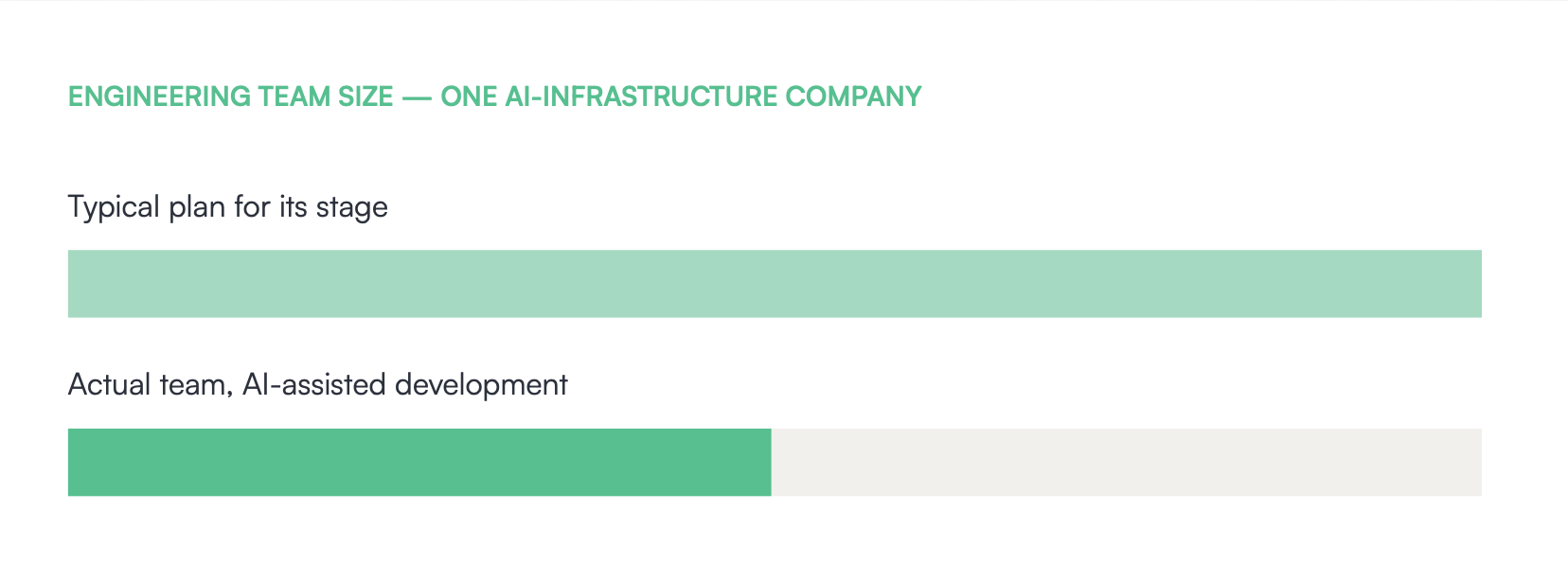
One company that builds infrastructure for running AI agents runs its engineering team at roughly half the size a typical plan for its stage would suggest. Because so much of its own development is AI-assisted, it reaches its roadmap milestones with fewer engineers and directs the budget toward more senior, higher-paid talent.
The savings do not come from AI replacing engineers. The tools are fast and capable, but they deliver the most value when experienced engineers are directing them and reviewing the output. A team without that senior oversight may find issues surfacing later in the build, when they are more expensive to address. A leaner plan still costs real money; it concentrates the spend in a smaller number of senior engineers rather than spreading it across a larger, more junior team.
None of this is limited to companies building AI products. A conventional startup can run leaner as well, but only if that leanness is by design. That means defining roles around the tools from the start, and assigning someone to track whether the smaller team is delivering the output the plan assumes.
Hiring Speed and What Investors Expect
Hiring the right people also takes longer than it used to. Every company is competing for the same narrow pool of senior engineers, which has pushed compensation higher and extended the time it takes to fill a role, even though those engineers ramp quickly once they start. How much of the work can be handed to AI is now one of the main inputs to the headcount plan, which adds a layer of judgment to hiring decisions that used to be more mechanical.
Investors have adjusted as well. They understand that senior engineers and heavy AI usage can raise the cost of building, and they are willing to back higher spend when the reasoning behind it is clear. The runway they expect to see has not changed much; most companies still raise to cover eighteen to twenty-four months or more. What has shifted is the basis on which spend gets evaluated. Investors used to gauge a plan largely by team size. Now they look closely at the reasoning behind how spend is divided between the team and the AI tools that support it.