AI is rewriting the assumptions behind every startup’s financial plan, often faster than the plan itself can keep up. This series looks at what that means for FP&A, one planning decision at a time — setting the plan, sizing the team, projecting runway, choosing metrics, and adjusting as the year unfolds. Each piece draws on what we’re seeing across the venture-backed companies we work with.
Every venture-backed startup runs on a financial plan. A financial plan is the operating model behind a company’s hiring, spend, runway, and revenue targets, and it connects those targets to how cash is actually spent. It is also the reference point for founders and investors to gauge whether they’re on track.
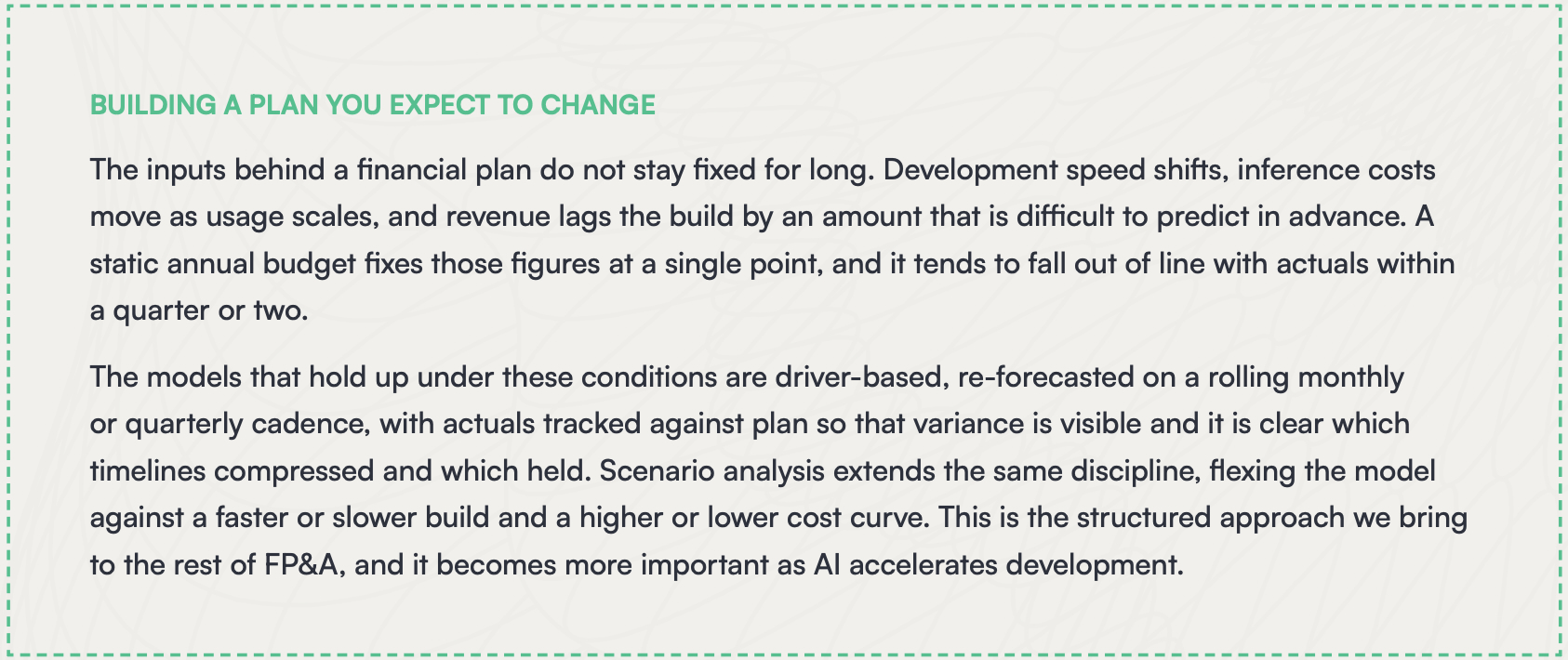
A financial model is only as reliable as its assumptions, and AI is changing several standard, long-standing assumptions for SaaS companies. Notably, AI adoption is reducing the time and cost it takes to build a product while also accelerating go-to-market timing. Developing an effective financial model in the age of AI means treating those assumptions as open questions rather than defaults.
Planning From the Development Timeline
At Attivo, we anchor every financial model to the development timeline. We start with the product roadmap to understand what the company needs to do to make that happen. We build headcount and spend from each milestone, then reconcile them against top-down targets to keep them aligned. Each milestone carries its own role-based hires and the infrastructure costs that come with them. When a date moves, the model moves with it.

AI has not replaced this method, but it has made the schedule less uniform. Some phases now compress sharply, while others remain generally the same. A plan that assumes AI accelerates everything evenly risks committing cash against unrealistic timelines.
Faster Products, Same Sales Cycle
Engineering is where AI has the greatest impact on pace and output. A few strong engineers using AI can develop and ship a product faster than ever, which can accelerate the go-to-market date.
While this accelerated development timeline may allow founders to hire a sales team earlier, it is unlikely to compress the sales cycle. Closing enterprise deals still depends on relationships and trust built over time. AI can broaden the top of the funnel and help size an opportunity, but the sales motion itself remains largely unchanged. A new account executive still takes time to ramp to quota, and the sales cycle still runs a similar number of months to close.

This means a gap may open between when a product is ready and when revenue actually arrives. Deals still require pipeline, relationships, and time. A financial model should reflect when revenue is truly likely to close, not when the product first becomes available to sell. The hiring plan should follow the product timeline; the revenue plan should follow the sales cycle.
Overall Costs and Savings When Using AI
Operating with a smaller engineering team does not automatically mean spending less. Fewer, more senior engineers, plus the AI tooling that supports them, may have roughly the same monthly burn as a larger team. The savings come from how long the build takes, not from the monthly run rate. A build that once took nine months might now reach the same milestone in six, so the total cost of the project falls by a third even though no single month got cheaper.
Another assumption worth challenging before it goes into the financial model is the size of the productivity gain itself. It is easy to expect a tenfold improvement from these tools. Engineers using them report something closer to three times, because the tools still have to be managed and fine-tuned, and senior engineers still have to review the output. A plan built on a tenfold gain sets a pace the team may never hit.
Don’t Let Guesswork Guide Your Growth
Attivo Partners works with venture-backed companies to build the financial models they need to plan with confidence. If AI is changing how quickly you build, what it costs, and when revenue arrives, our FP&A team can help you build a model driven by your development timeline, classify AI and infrastructure costs correctly, and keep the plan current as the numbers move. Learn more; contact fpa@attivopartners.com.