AI is rewriting the assumptions behind every startup’s financial plan, often faster than the plan itself can keep up. This series looks at what that means for FP&A, one planning decision at a time — setting the plan, sizing the team, projecting runway, choosing metrics, and adjusting as the year unfolds. Each piece draws on what we’re seeing across the venture-backed companies we work with.
A financial plan relies on a handful of metrics, which ultimately tell a founder whether growth is real, efficient, and worth funding. For years, those metrics were stable because the underlying pricing was stable — fixed subscriptions, recognized ratably over the contract term. Usage-based pricing alters that foundation. When a customer’s spend rises and falls month to month, contracted ARR and net revenue retention no longer give the full picture of what is happening in the business. Other measures, including run rate, Gross Margin, and CAC payback period (on Gross Margin), become more relevant. The first task in building a usage-based plan is determining which of these metrics to rely on.
From Subscriptions to Usage and Outcomes
Among the AI companies we work with, a flat per-seat subscription increasingly fails to cover what it costs to deliver the product. Customers are also reluctant to pay a fixed fee before the value of the product is established. They prefer to pay for what they consume or for the results the product produces — through consumption-based pricing, a percentage of revenue, or a fee tied to a measurable outcome. When revenue is earned that way, the metrics worth tracking change with it.
Rethinking the Core Metrics
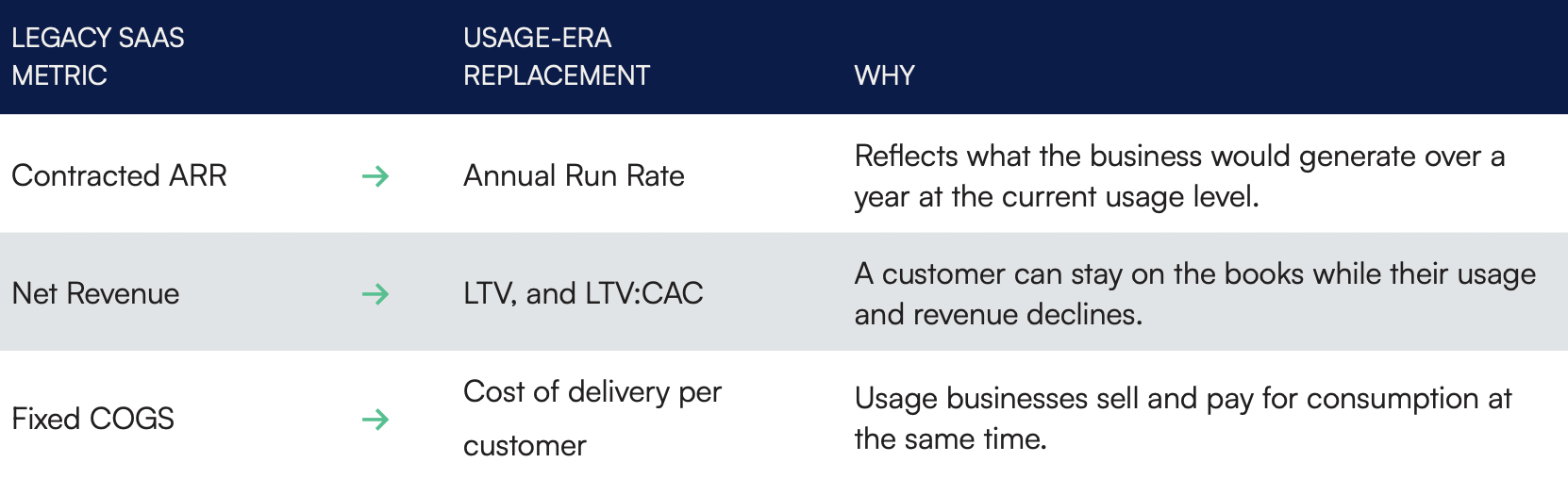
ARR is the clearest example of a metric whose meaning is changing. Among usage-based companies, the term increasingly refers to annual run rate rather than annual recurring revenue. Once revenue moves with usage, the contracted figure carries limited information, and the more useful number is what the business would generate over a year if the current month’s usage continued. Run rate becomes the more accurate measure of growth.
Variable usage also weakens the standard SaaS retention measures, which were built for stable subscriptions in which a customer either renews or churns. When spend rises and falls month to month, a customer can remain on the books while the revenue that customer generates declines, so a healthy retention rate can conceal a shrinking account. Gross margin becomes a more useful gauge, along with the CAC payback period (on Gross Margin), because both account for variable revenue and the net contribution to the business.
Gross Margin in a Usage Model
Gross margin remains central in a usage model, and managing it requires more than tracking cost of goods sold as a percentage of revenue. A usage business sells usage and pays for it at the same time, so the first step is to allocate AI costs to the right categories. Allocation does not change what the company spends in a month, but it determines whether gross margin and the metrics built on it are accurate. From there, the team matches what a customer’s usage brings in against what it costs in AI consumption to serve that customer. If pricing is not adjusted as delivery costs change, gross margin declines.
Because pricing and cost of delivery move together, finance needs to be involved when pricing and product decisions are made. Companies that manage this well build their financial model on run rate and net contribution rather than contracted ARR, track the CAC payback period more closely than retention, and model gross margin from the actual cost of delivery rather than a fixed percentage. Managed this way, a usage model gives a company a clearer view of what each customer costs to serve and what each customer is worth than fixed subscriptions provide.
Don’t Let Guesswork Guide Your Growth
Attivo Partners works with venture-backed companies to build the financial models they need to plan with confidence. If AI is changing how quickly you build, what it costs, and when revenue arrives, our FP&A team can help you build a model driven by your development timeline, classify AI and infrastructure costs correctly, and keep the plan current as the numbers move. Learn more; contact fpa@attivopartners.com.